August 16, 2010

Loss of Chance/Opportunity: New Opinion from Michigan

The Michigan Supreme Court came out a few weeks ago with a very interesting opinion in favor of the Plaintiff in a malpractice claim that most likely would fail in Maryland.

The doctor's malpractice attorneys argued that the allegation that the doctor's negligence caused a reduction in the risk of stroke from 10 to 20 percent to less than 5 to 10 percent was not enough to get the claim to a jury because the loss was not sufficient enough to meet the burden of proof on proximate causation. The doctor argued that Michigan law is whether the opportunity to achieve a better result was greater than 50 percent. Under this law, if the plaintiff could not prove that receiving the alleged appropriate treatment would have decreased his risk of injury by 50%, plaintiff's claim would fail.

Thankfully, a divided Michigan high court found that this is not the law and that malpractice cases such as this should be decided under a simple principle: the plaintiff is required to prove that the doctor's negligence more probably than not caused the plaintiff’s injury.

Regrettably, Maryland goes in a different direction on these types of cases as I have previously discussed. One thing Maryland has Michigan beat on is collegiality among the judges on the court. Battles in the Michigan Supreme Court are both political and personal in a way that would shock Maryland lawyers. Judges quoting political statements made by other judges to the press, the judge that wrote the majority opinion writing separately to refute one judge's personal attack - if you have no interest in this issue it is worth reading the opinion just to get a taste of what this different world is like.

Continue reading "Loss of Chance/Opportunity: New Opinion from Michigan" »

| Share
August 12, 2010

Malpractice Verdict in Baltimore

Miller & Zois lawyers Laura Zois and Rod Gaston obtained this afternoon a $1.1 million verdict for our client in a medical malpractice (lap chole) case in Baltimore City.

| Share
August 12, 2010

Medication Error Verdicts

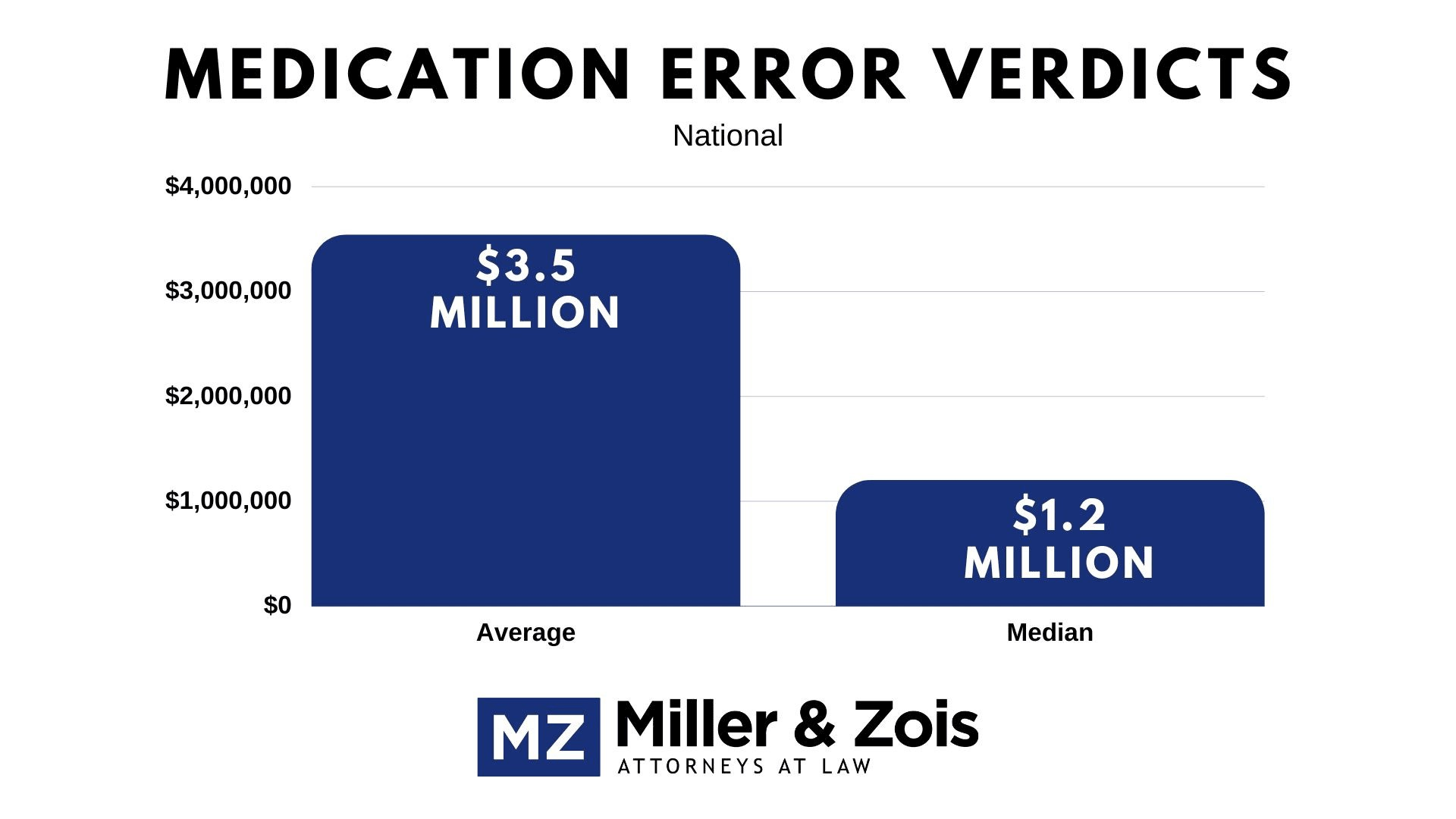
A new Jury Verdict Research study found that the average verdict in an improper medication case is $3,539,541. The median, which many consider to be a more accurate number, is $1.2 million. Verdicts ranged from $2,074 to $35,500,000. But only 28% of medication error plaintiffs recover at trial. I think the problem in many medication error cases where plaintiffs do not prevail is causation because sometimes the medication error compounds a larger pre-existing health condition and it is difficult for the jury and the doctors to sort it out.

Incredibly, 1.5 million people are victims of medication errors every year, according to an Institute of Medicine study from a few years ago. Of course, most of these errors are relatively harmless. We get frequent calls from people who are justifiably angry that such a careless error was made. But, more often than not, they don't have a case because they were not significantly injured (in the malpractice sense of the word, anyway). Still, more people die annually from medication errors than from on-the-job injuries, according to the National Coordinating Council for Medication Error Reporting and Prevention, and the extra medical costs incurred from improper medication errors each year is a whopping $3.5 billion.

| Share
August 9, 2010

Nursing Home Arbitration Clauses in Maryland

One case I have been meaning to write about for a few months is Dickerson v. Longoria, a recent Maryland nursing home opinion.

The ultimate issue in Dickerson is whether a family member had the authority to bind a nursing home patient by agreeing to an arbitration clause. The Maryland Court of Appeals found that the relative did not.

But the larger issue is whether Maryland law allows for enforcement of a nursing home negligence arbitration agreement. I think it is hard to argue that a waiver signed at admission even if signed by the patient is a knowing, intelligent, and voluntary waiver of one of our most fundamental constitutional rights: the right to a jury trial.

The Maryland high court does not address this issue but also does not raise the issue. Some will interpret this as a sign that the court did not question a Maryland nursing home’s right to enforce arbitration clauses with its residents. I think this is the wrong interpretation because courts only need to decide the issue in front of them. Still, it would have been nice to see a footnote questioning the entire premise of nursing home arbitration agreements.

This case underscores the unfairness of these nursing home agreements in Maryland. One notable example: the nursing home in Dickerson reserved for itself the exclusive right to select an arbitrator. Maryland just should not allow nursing homes to stack the deck in their favor because someone - most likely under some duress - signed a small print arbitration clause upon admission to a nursing home.

You can find the full opinion here. Normally, I link to the Maryland appellate opinion site but I really think it is easier to read this opinion on Google Scholar.

| Share
June 28, 2010

Michael Jackson Wrongful Death Lawsuit

Michael Jackson's father has filed a wrongful death lawsuit against his son’s doctor. The lawsuit alleges what you would expect: the doctor's negligence was the cause of Michael Jackson's wrongful death.

This wrongful death case is arguably worth over $1 billion because of the potential future lost wages. The only bigger malpractice case I can imagine: anyone touching Tiger Woods before Bimbogate. Oh, and Oprah. How could I forget Oprah? Actually, you could throw Bill Gates in there or a few others. I'm overstating my point. Still, you get the idea. The potential damages in a wrongful death case involving Michael Jackson would be incredibly high.

But the problem is that most malpractice cases, including this one, are damages limited by the insurance the doctor has which, in this case, is reportedly $1 million. But given the potential criminal conviction and the damages, I would not be surprised to see the malpractice insurer rushing to put up the $1 million policy if it has not already been offered.

| Share
May 12, 2010

Mediation Article with Judge Clifton J. Gordy

The Maryland Daily Record published a three part series over the last month on mediation in Maryland personal injury cases, a piece I wrote with the Honorable Clifton J. Gordy . You can read the articles on-line but you have to be a subscriber to the Daily Record to read the entire article.

  • Part I of Mediation in Personal Injury Cases
  • Part II of Mediation in Personal Injury Cases
  • Part III of Mediation in Personal Injury Cases
April 27, 2010

Wrongful Death Compensation: How Much?

I stumbled on an interesting Chicago Law Review article today by Eric Posner (Judge Richard Posner's son) and Cass Sunstein (now with the Obama administration). I like Sunstein's views on a number of issues, including animal rights.

The subject article is how the legal system assigns money damages to the loss of human life in wrongful death cases with an eye towards creating greater uniformity. The authors approach this question like it was a mathematical equation to be solved. For grief, the authors conclude that $500,000 is a good starting place, suggesting this formula as the paradigm to determine compensation in wrongful death cases:

To derive a willingness to pay (WTP) to avoid grief from a spouse's death, one would need to (1) determine the average length of time that the grief persists (for example, until remarriage); (2) find an equivalent happiness difference in an area of life that has been reliably monetized (for example, willingness to pay to avoid disease or depression); (3) convert this difference into annual units; and (4) multiply (1) by (3).

I understand the goal of uniformity and I even understand the formula. The problem is homogenizing the equation for everyone. Values vary because juries vary but also because facts vary wildly from case to case. Moreover, the formula is artificially low because it uses how much you will spend to avoid a loss to determine how you value the loss. For example, if you are willing to pay $5 to avoid a 1/100,000 risk of death to your spouse, than the loss of your spouse is worth $500,000.

Continue reading "Wrongful Death Compensation: How Much?" »

April 26, 2010

Should You Ask for an Amount in Opening?

Paul Luvera discusses a tough issue for Plaintiff's lawyers: do you clue the jury in during your opening statement as to how much you are going to ask for in closing? I struggle with this and often opt for a middle ground. I lay out the foundation of what I'm going to ask for: medical bills, wages, and the formula I think is appropriate (x per day for the rest of her life). This way, I'm getting them used to the idea without having to spit out a number without any evidence.

As Paul points out, a one size fits all rule is difficult because each case depends on different facts. One critical question has to be considered: is the cap an issue? If what you have is clearly a cap case and minimal or no economic damages, you can dial back a bit on the damages argument which might help you avoid the risk of losing credibility. Because every time you ask for money - which is what a plaintiffs' lawyer does by definition - you do lose some measure of credibility with a jury.

One of the issues in this post - raising the damage amount in voir dire - is not of much interest to Maryland personal injury lawyers because our voir dire is so ridiculously limited.

Paul also points out that David Ball feels pretty strongly about putting up a number in opening. Which is reason enough to consider it in every case.

April 13, 2010

My Mediation Article with Judge Gordy

Yesterday, the Maryland Daily Record published the first of a three part series I wrote with retired Judge Clifton J. Gordy (now a mediator and arbitrator) on mediation in serious personal injury and wrongful death claims. The article is for both plaintiff and defense lawyers looking to make mediations as productive as possible. Take a look at yesterday's article and look in coming editions for the final two parts.

March 17, 2010

Lawyer v. Lawyer Lawsuit Decided By Maryland Court of Appeals

In a 6-1 opinion, the Maryland Court of Appeals decided Blondell v. Littlepage, affirming the Court of Special Appeals decision which rejected a tort and breach of contract lawsuit brought by a lawyer against a malpractice lawyer regarding a case he referred to her.

The lawyer referred a cancer misdiagnosis case involving an allegedly misread mammogram to a malpractice lawyer. Both lawyers agreed to a fee split. The original lawyer had already filed the malpractice lawsuit on behalf of the Plaintiff, before referring the case out. I'm not sure what the referring lawyer was thinking when he filed suit. Perhaps he was hoping the case would settle or maybe he later decided the client would be better served with a lawyer who focuses on malpractice cases. The court does not indicate the reason for the referral.

Anyway, the case settled for a lot less that the pretrial judge recommended, which upset the referring lawyer, as did the suggestion allegedly made by the malpractice lawyer to the client, that the referring lawyer's failure to timely file the case with the court decreased the settlement value of the case. The malpractice lawyer went so far as to give the client names of legal malpractice lawyers to bring a claim against the referring lawyer.

Continue reading "Lawyer v. Lawyer Lawsuit Decided By Maryland Court of Appeals" »

| Share
March 14, 2010

Medical Errors and Admitting Mistakes

The New York Times has a story about encouraging doctors to admit their own mistakes. The UCLA surgeon who wrote the article does not contend that admitting medical mistakes should take the place of civil accountability. In fact, she suggests - as some recent literature has indicated - that being forthcoming about medical errors may decrease the number of medical malpractice lawsuits.

I'll admit that while I was reading this story I was circling around ready to pounce when the author suggested that we needed to eliminate malpractice lawsuits in order to get doctors to be able to freely admit mistakes. So let's just pretend, channeling my inner Glenn Beck, the author made that contention so I can refute it. In my defense, I'm not exactly creating a straw man. This argument has been made countless times, that it is somehow safer for patients for health care providers to be able to treat patients in a lovey environment where there is no risk of responsibility for medical errors.

First, let's admit that we are all loathe to admit mistakes. I don't think taking away the risk of a malpractice lawsuit - for which the doctor has insurance in most cases - is going to substantially change the frequency of admission of medical errors.

More importantly, where is the justice in being exculpated for causing a life altering injury because you admit you did something wrong? If a driver crosses the center line and kills someone, can we just move on if the driver admits a mistake? (Bonus argument: accidents are a "known risk" of driving a car, right?) How about if personal injury lawyers who blow a statute of limitations can avoid responsibility by making the grandiose admission that it is all their fault? Wouldn't that help lawyers understand their mistakes? What? Lawyers should buy a calendar? Well, yeah, that would be a good idea too.

Continue reading "Medical Errors and Admitting Mistakes" »

| Share
February 18, 2010

New Michigan Malpractice Rule

The Michigan Supreme Court issued an order requiring defendants in medical malpractice lawsuits to challenge deficiencies in Plaintiff's attorneys’ notice of intention to sue and certificate of merit within 63 days of service. This rule also applies to challenges of the qualifications or eligibility of the signer. (The court did allow an "except for good cause" which may lead to a lot of litigation over just how much discretion judges will have with respect to what constitutes good cause.) Perhaps more importantly, an amendment to a certificate of merit now relates back to the original date of the filing of the affidavit.

One problem this rule is intended to rectify is when defendants’ malpractice lawyers intentionally sandbag potentially legitimate objections until after limitations passes and then try to get the case kicked for some procedural deficiency. Now, malpractice plaintiffs with procedural deficiencies can amend so that the statute of limitations does not pass. In other words, substance triumphs over silly procedural nonsense. In my world, this is a good thing.

Depressingly, the short AP story on this ruling characterizes the case in partisan terms that would hit an odd cord with any Maryland lawyer unaccustomed to the injection of party affiliation in reports on appellate court rulings:

Republican Elizabeth Weaver joined Democrats Marilyn Kelly, Michael Cavanagh and Diane Hathaway in supporting the change in the order issued Wednesday. Republicans Maura Corrigan, Robert Young and Stephen Markman opposed the change.

I think I could accurately predict how each Maryland Court of Appeals judge voted in the 2008 presidential election. Still, we are blessed in Maryland to be able to largely keep judges’ voter affiliation and raw politics out of appellate decisions. The difference is that Michigan elects their judges which pushes politics to the forefront. The lesson, as always: judicial elections are foolish. (Parenthetically, retired Baltimore County Judge Dana Levitz made a great argument against judicial elections in the last issue of the University of Baltimore Law Forum. I wrote about the insanity of judicial elections four years ago here and last year here.)

One of the dissenting opinions gets incredibly personal in its attack, arguing that two of the judges contradicted their own positions taken in administrative conferences, encouraging interested parties to go back and watch the online video of the conferences. You would never see this in a Maryland appellate court or a Supreme Court opinion. I had no idea of how civil we are in Maryland until I read this opinion.

You have to read the entire opinion. You can find it here.

| Share
February 17, 2010

Defensive Medicine

In the Tennesseean, an emergency room doctor admits to performing unnecessary tests to avoid malpractice lawsuits:

In my personal practice, if I knew that I couldn't be sued except for things that I truly believe I should get sued over, I could eliminate half of my lab tests, two-thirds of my X-rays and 90 percent of my CT scans because all of those tests are done for my protection, not the patient's.

In other words, this doctor admits to ordering tests that can harm and cause risk to a patient - as CT scans and x-rays certainly do - for his own protection to avoid a malpractice lawsuit for which he has insurance.

I'm not sure what is more depressing, the fact that the doctor blithely admits this to a reporter thinking it is an acceptable medical practice to put his own interest ahead of the patient or the fact that there will be no ramifications for this doctor. If a lawyer or an accountant made the same admission - that he/she put their interests first ahead of their clients - the Internet would explode.

Thankfully, the vast majority of doctors put their patients first.

| Share
February 17, 2010

Federal Malpractice Cap

Let's say Barack Obama decides to take a strong position on medical malpractice caps and puts his weight behind a bill to eliminate malpractice and other damage caps in all 50 states.

This would be a huge windfall for our practice. But I would oppose this legislation. Why? Because such a law would be a ridiculous intrusion into the affairs of the States by the federal government. The federal government has no business telling the states they cannot have caps on damages. (I think caps violate state constitutions because they are a legislative intrusion on the separation of powers every state has in its constitution. But that is a different blog post.)

How, then, can tort reform advocates - who are almost to a person far more 'States rights, get government out of our lives" than I will ever be - support this unprecedented intrusion of caps on damages in medical malpractice cases via a health reform bill? It is because most tort reformers have a world view: lawsuits are bad, caps are good. They will push for this goal by all means necessary, including shedding inconvenient authentic core values.

| Share
February 8, 2010

Baltimore Sun on Malpractice Courts

The Baltimore Sun continues to push the idea of medical malpractice cases being placed into some sort of health court. Naturally, as is their practice, the Sun offers no real details and no balance to the editorial besides blaming trial lawyers for everything but the Blizzard of 2010. More problematically, they support a solution without really identifying a problem. What is the evidence of a problem with the judges that are currently handling medical malpractice lawsuits in Maryland? This would seem to be a prerequisite to offering a solution.

The Sun thinks that the governors of this state have nominated judges that cannot understand how to administer medical malpractice lawsuits. Either this is nonsense or we have a gubernatorial malpractice claim against Governors Mandel, Hughes, Schaefer, Glendening, Ehrlich, and O'Malley. I'm going with the nonsense theory myself. It is also silly to suggest that doctors are so vested in this idea. Even if trained malpractice judges are better malpractice judges, I don't think anyone has any idea of whether having malpractice specific judges is going to help plaintiffs or the doctors' lawyers in discovery or at trial.

The Sun goes on to tout the importance of a new "I'm sorry" law so doctors can admit they screwed up. On its face, it sounds okay. There is evidence that patients and their families benefit when doctors disclose medical errors and apologize. But did we do a study as to how these same patients feel when these apologetic doctors admit to their patients what they did but then can make a farce of that admission by denying it publicly later? Will this make a mockery of the victims and the court who sanctions what is going to approach or reach perjury?

The reality is a sympathetic "I'm sorry" when any professional (or even the other driver in a car accident) makes a mistake is going to make it less likely that the victim is going to bring a claim. Doctors should say they are sorry because it helps the patient, themselves and because it is the right thing to do, not because they are given immunity for the apology.

I also don't think the law is going to make much difference. Good, decent doctors (the vast, vast majority) will apologize if they think they make a mistake. Doctors that won't because they fear malpractice probably wouldn't apologize anyway.

| Share
February 5, 2010

Illinois Malpractice Cap Ruled Unconstitutional

The Illinois Supreme Court made big news nationally when it issued its much awaited opinion in Lebron v. Gottlieb Memorial Hospital yesterday, The court overturned in a 4-2 ruling the Illinois five-year-old medical malpractice cap on damages because limiting compensation for injured malpractice victims for pain and suffering violated the Illinois constitution.

Specifically, the court found that the Illinois malpractice cap violated the “separation of powers” clause because imposing a cap imposes on a decision that should be made not by legislatures but by juries.

The underlying lawsuit involves a catastrophic birth injury. Plaintiff’s lawyers alleged the infant Plaintiff’s severe cerebral palsy was caused by the negligence of the hospital, her obstetrician, and a nurse.

The appellate path taken in this case was atypical. Plaintiff sought summary judgment on the issue of whether the cap applied, which the trial court granted before the case was tried. Procedurally, this is odd and the dissenting opinion took exception to the idea of deciding this case without a verdict. I understand the dissent’s thinking on this. But the parties at least are best served taking this path because they both know how the law is going to be applied. This makes the case much easier to settle and settle fairly whichever direction the court takes. After the trial court’s ruling, the Defendants appealed directly to the Illinois Supreme Court.

Essentially, the court found that a cap on damages is a legislative remittitur and the failure to leave the issue of remittitur to the court which decides the issue on a case-by-case basis represents legislative intrusion on the powers vested in the court by the Illinois constitution.

One favorite part of the opinion for me was the way the court responded to the defendant’s argument that other states had damage caps: “That ‘everybody is doing it’ is hardly a litmus test for the constitutionality of the statute.”

Continue reading "Illinois Malpractice Cap Ruled Unconstitutional" »

| Share
January 29, 2010

St. Joseph's Stents and Lawyers

The Baltimore Sun has an interesting article on the race among lawyers to attract St. Joseph stent lawsuits that includes some quotes from me.

| Share
January 27, 2010

Defense Verdict in Medical Malpractice Lawsuit in Baltimore

A federal court jury in Baltimore found that an Elkton obstetrician was not liable in a medical malpractice lawsuit. The core of the case is bound to raise moral concerns with at least some jurors. Plaintiff claimed she would have terminated her pregnancy if she had been advised that her child had Down syndrome, claiming the child’s expected future medical care was projected to be as much as $16.4 million.

The plaintiff claimed that her triple screen blood test found that she had a 2.6% chance her daughter would be born with Down syndrome. The case was a classic case of he said/she said. The doctor claimed the patient was told three times of her test results and that she rejected the doctor’s suggestion that she get the more invasive amniocentesis test.

Most likely, the jury believed the doctor’s notes were accurate and made contemporaneously with his discussions with the patient regarding the results. Only the doctor, the Plaintiff, and God know exactly what information was conveyed. But I also wonder the extent to which this federal jury had a problem with the “I would have had an abortion” claim from Plaintiff. Statistically speaking, someone on that jury strongly believed that abortions are immoral.

Continue reading "Defense Verdict in Medical Malpractice Lawsuit in Baltimore" »

| Share
January 15, 2010

St. Joseph's Scandal

St. Joseph Medical Center in Towson, a hospital known and respected in no small measure for its cardiology department, is being accused of conduct that goes well beyond medical malpractice. The allegations are beyond stunning: at least 369 of St. Joseph's heart patients have received coronary stents that were not medically necessary, putting these patients at greater risk of complication or further injury. People with minimal blockages were allegedly given stents and told they had near complete heart blockages.

Stents are used to fight artery blockages. St. Joseph Medical Center is a hospital that puts in a lot of stents. Many patients drive past University of Maryland Hospital and Johns Hopkins Hospital to get stents put in at St. Joseph's. Think about how remarkable an accomplishment this was for St. Joe. Now, one doctor trying to earn a few extra bucks may have tarnished the reputation of a hospital and a lot of great work done by a lot of great doctors, nurses and other health care providers. Obviously, the biggest tragedy is the patients who have been subjected not only to an unnecessary heart procedure, but have likely also been over- medicated, as if their condition had been more serious. But I also feel bad for the good guys at St. Joseph who were not involved in any of this and are now tarnished by it all.

The doctor at the center of this scandal lost his privileges at the hospital last summer without notice to his patients or any comment from hospital officials. There is a lot of information that needs to come out, but this raises the obvious question: if hospital officials knew something was going on, why wait so long to convey this information to patients? If it is important for St. Joseph's to tell patients now, why were patients not told this summer? I don't want to prejudge this, but it is a question that is going to be raised.

Do these 369 patients have malpractice claims? I don't think there is going to be significant injury in most of the cases. But you can certainly expect some valid claims to arise. Moreover, this is a a classic - and rare in the real world - case of a malpractice lawsuit that has a great settlement value than trial value. Because St. Joseph's has to be eager to settle these claims and put this debacle behind them.

| Share
January 13, 2010

Maryland Medical Malpractice Cap Opinion: Plaintiffs Lose. Big.

In a 7-0 decision, the Maryland Court of Appeals overturned a Montgomery County trial judge’s ruling in Lockshin v. Semsker that Maryland’s medical malpractice cap applies to all malpractice lawsuits, including those where one of the parties waived health claims arbitration.

But that is not the only blow the opinion gives to Maryland malpractice lawyers and their clients. The court also ruled that because the cap applies, any pro rata reduction – in this case $1 million – applies after the cap has been applied. The practical difference in this ruling for the Plaintiffs in this case is that it reduced their already reduced jury award from $2,172,936 to $1,766,686, a difference of more than $400,000.

The practical impact of this rule? The exact opposite of what the Maryland legislature wants: more malpractice trials. Applying a "cap first" approach will encourage defendants not to settle because if the non-settling defendants believe that the plaintiff has negotiated a good settlement (which is often the case when one party settles and the other does not), remaining defendants are going to be more willing to roll the dice to get the full benefit of plaintiff’s good settlement.

Finally, in a non cap related issue, the court also ruled that if medical bills have been waived, Defendant can seek, via a post trial motion for remitter, to reduce the verdict by the amount of the waived or reduced bills after the verdict.

Continue reading "Maryland Medical Malpractice Cap Opinion: Plaintiffs Lose. Big." »

| Share